Where does the Bible come from?


Can we trust the Bible? Why should we believe that it’s true? These are questions that are often put to Christians, and for which Christians should have a ready answer.

One of the ideas out there today is that a group of church officials at the Council of Nicea (AD 325) arbitrarily chose the books they wanted to put in the Bible, and in the process invented the religion of Christianity. This is the view presented in the Da Vinci Code book and movie. But despite the fact that this book admits to being fictional, many people have accepted it as a fact. So is this what really happened?  Not even close. So what did happen? Where do we get our Bibles from?

Belshazzar and the Writing on the Wall (Dan. 5)


“He should have seen the writing on the wall!” This expression means there was clear evidence—evidence that was ignored—of a bad or dramatic event about to happen.  The connection with writing on a wall traces all the way back to the Bible. It refers to a miraculous event in the life of Daniel the prophet, an event that preceded one of the most dramatic moments in all of history:  the night the Babylonian Empire was destroyed. This event is recorded not only in the Bible, but in other ancient writings as well.  By putting all these sources together, we get unparalleled insight into one of the greatest turning points in history.  

To understand how important and dramatic this moment was, we need to set the stage with a bit of background.  This took place when the Jewish people were in exile in Babylon, one of the lowest moments in their history.  As it says in the opening verse of Psalm 137:  “By the rivers of Babylon—there we sat down and wept when we remembered Zion” (Psa. 137:1).  Their exile meant the end of Israel’s existence as a kingdom, the end of their national sovereignty.   It looked very much like the final chapter in God’s special relationship with the Jewish people.

Jacob in Haran and Back Again (Gen. 29-32)


Recently, we began to talk about Jacob and his trip to Haran.  We talked about the dream he had at Bethel—the dream of the ladder—and the promise he made to God there.  We also talked about how he fulfilled that promise many years later when he got back to the Land of Israel.

Today we’re going to talk about the rest of Jacob’s adventure:  his time in Haran and how God used that time to shape him into the man of God he later became.  Because if there’s one thing we know for sure about Jacob, it’s that when he started off in life, he was trouble.  Oh yes, he was a good boy, a mama’s boy (Gen. 25:27,28).  But he was also a liar and a cheater; a deceiver.

Jacob’s Vision of the Ladder (Gen. 28)

Bethel:  site of Jacob's Vision

Jacob’s vision of the ladder has inspired many through the centuries.  Maybe you’ve heard the song “We Are Climbing Jacob’s Ladder” (new tab: audio).  It’s a famous African American spiritual that understands Jacob’s ladder as a symbol of the believer’s spiritual ascent into heaven.  The ascent is slow and agonizing, but the result is glory.

The slaves who sang this song weren’t the first to find spiritual meaning in Jacob’s vision.  The early Church understood it in a similar way.  Origen in the 3rd cent. AD understood the ladder to be a picture of the soul’s ascent to God after death.  He also saw it as a picture of increasing virtue in the life of the believer.  This understanding was closely linked to the monastic ideal of asceticism: the idea of denying the world and denying worldliness in order to follow Jesus.

One of the most famous expressions of this idea was the book, The Ladder of Divine Ascent (new tab: pdf) (7th cent. AD). Here again, the ladder is understood to be one that we must travel on to reach God in heaven.  But the original vision of Jacob was quite different. Instead, God used the ladder to come down to meet with Jacob on earth. He came to prepare him for the dangers of his trip to the distant city of Haran. And in the process, he also prepared us for the coming of the divine messenger of God, a messenger who is himself God: God’s Son who would appear in human form as Jesus.

Images of Prayer in the Worship of Israel


Acts 3:1:  "But Peter and John were going up into the Temple for the hour of prayer, the ninth hour." 

So often through the years, Christianity has been presented as a total break with Judaism, a completely different religion that has nothing in common with the ancient religion of the Jewish people.  Instead Christianity has been presented as a philosophical faith that has more in common with Greek philosophy than with the Bible.  But if that's true, why were Peter and John coming here, to the Temple, to pray, after the resurrection and ascension of Jesus?  (Jesus ascended to heaven in Acts chapter 1, this is chapter 3.)

Scripture Garden II

Well and Watering Troughs

Last week we talked a little about the Scripture Garden where my wife and I used to work.  We covered about half of the items in the garden, and this week we’ll take a quick look at the other half.

Scripture Garden I

Biblical Resources Scripture Garden at Tantur

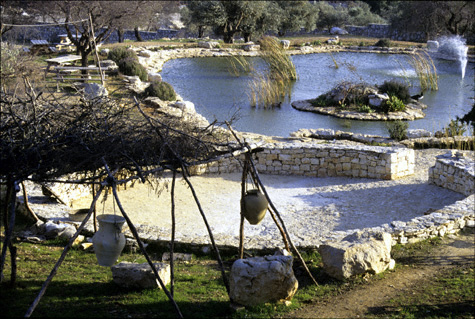
Today I’d like to share with you the first part of a walk through a Scripture Garden that my wife Karen and I used to work at in Israel.  This garden was located halfway between Jerusalem and Bethlehem.  It's no longer there today, but has inspired many imitators that carry on the tradition. What was in the Scripture Garden?  More than two dozen full-sized models and restorations of objects from daily life in Bible times.

The purpose of the garden was to help you understand the imagery of the Bible.  Many times we read about different things like wells or threshing floors or wine presses or olive presses in the Bible, but we really don’t understand what they were or how they worked.  And since so much of the imagery of the Bible depends on this knowledge, we often don’t understand the meaning of this imagery, and so don’t understand the meaning of the verse or section it appears in. 

Hebrews 2


Last week, in Hebrews chapter 1, we saw how the book of Hebrews begins:  by identifying Jesus as the Son of God, who is the “character”—the impress or exact likeness—of the Father.  Because of this, he is infinitely greater than any of the angels.  And to prove it, Hebrews quotes verse after verse from the Bible, to show that Jesus is far greater than the angels.  The angels are spiritual servants, but Jesus rules and reigns at the right hand of the Father in heaven.


The Land of Israel

This is a quick draft of the sermon from Sunday, April 12th.  Sorry about some of the rough spots and abbreviations (N is north, S is south, E is east, W is west).  I know this is difficult to understand without the maps and photos.  I hope I’ll be able to add them some time. 

CREDIT:  This is one of the lectures developed by Dr. Jim Fleming and the staff of Biblical Resources in Jerusalem that we would give to Christian tourists when they first arrived in Israel as a general introduction to the land.  We sometimes call this the 5-4-3-2-1 lecture. 

The Bible is like the script of a play or film.  By reading it, you can get a good sense of the plot.  You can appreciate much of the dialogue.  But you have to rely on your imagination to fill in the details.  That's fine if you're reading a story of events in your own country and your own generation.  It’s easy to understand the customs and the setting of your own time and your own people. 

But what if the story takes place far away, in a distant time and culture, with a different language and people?  Your imagination will paint a picture--but that picture will be quite different than the reality.  You will miss the point of strange customs and sayings.  And you will misunderstand some of the actions.  This is the problem we have when we read the Bible:  the action is in Israel in the Middle East, thousands of years ago, in the Hebrew (or Greek) language, and among a Semitic people and society very different than our own. 

Hebrews 1

This is a quick draft of Sunday's sermon.  Hopefully I'll eventually replace it with a more polished version.

It’s always interesting to me that so many people talk about having a relationship with Jesus.  This is a relationship that’s often presented as the means of salvation:  that we are saved by having a relationship with Jesus.  Right?  Have you heard that?  Of course.  But what kind of relationship with Jesus is the Bible actually talking about?  I would think that would be a very important question.

Messianic Kingdom II


After the questions last week, I could see that I didn’t answer some of the most important questions that people had about the Messianic kingdom.  So I thought I’d spend a little more time on this topic to answer those questions in a better way.  Is that okay? 

The Messianic Kingdom


Resurrection is one of the central and most dramatic beliefs of the Christian faith:  that we all, good and bad alike, will be raised from the dead and judged by God; a judgment that will determine our fate for eternity.  The New Testament teaches that there will be two of these resurrections, one for the righteous—those who have accepted Jesus as Lord and lived according to his teachings—and one for the unrighteous.  The time between these two resurrections will be a glorious age of peace and blessing, a Messianic kingdom, in which the righteous will rule and reign with Jesus on this earth for a thousand years.  This coming golden age should be the hope and the desire of every true Christian. 

Sermon on the Mount III

View from the site of the Sermon on the Mount

It’s been a little while since we left off our discussion of the Sermon on the Mount, the most important sermon in Jesus’ ministry.  So I thought today would be a good day to get back to it and continue to talk about these teachings which are right at the core of Jesus’ instructions for our lives today.

The Binding of Isaac (Gen. 22)

The High Place at Petra

One of the strangest events recorded in the Bible is when God asked Abraham to sacrifice his son Isaac.  How can we understand this strange and shocking event?  I hope, if you ever feel that God is leading you to sacrifice your child, that you will say “No!” and will quickly identify the source of this thought as the devil and not God!  But yet this is what the Bible says God commanded Abraham to do:  to kill his son.  How do we make sense of that?  How could the God of the Bible even think of such a thing, let alone command it; and how could Abraham accept that this was from God?

The Man Dressed in Linen (Eze. 8-9)


Do you remember that once before, we spoke about the dangerous vision of the Chariot:  the chapter in the Bible that is so dangerous, it’s not permitted to be read in the synagogue?  Do you remember which chapter that was?  It was Ezekiel 1, the first vision of Ezekiel.  And do you remember what was in the Chariot?  A radiant man that glowed like glowing metal.  And who did we say that radiant man was?  Jesus, Yeshua, the Son of God.  Today we’re going to talk about another of Ezekiel’s visions, about a year later, when he saw the Chariot and the radiant man again.

The Feast of Tabernacles


Hag Sameach!  (“Happy holiday!” in Hebrew)  Today is the fourth day of the Feast of Tabernacles (Oct. 12, 2014).  It started last Wednesday evening at sunset (Oct. 8), with a Sabbath rest, and will continue until this coming Wednesday at sunset (Oct. 15), when it will be followed by an additional day of rest (Oct. 16).  This is the festival that we will be celebrating with other churches in Hsinchu next Sunday (Oct. 19)! 

The High Holy Days


This is a very special and holy time in Israel, known as the High Holy Days or the “Days of Awe.”  It began with Rosh Hashanah, the Biblical Feast of Trumpets, the week before last (Sept. 25).  Next came the Day of Atonement, the holiest day of the Jewish year, which ended yesterday (Oct. 4) just after sunset, and then the Feast of Tabernacles begins this coming Wednesday at sunset (Oct. 8). 

Sermon on the Mount II

Location of Jesus' Sermon on the Mount

If there is one message that every Christian should know, it’s Jesus' Sermon on the Mount.  It’s the clearest example in the Bible of the Way of Jesus:  the way that he lived and the way he wants his followers to live, too.

The Tower of Babel (Gen. 11)


A couple of weeks ago, we talked about the Flood of Noah:  both the physical and the historical evidence that this huge catastrophe actually took place just as the Bible and other ancient histories say it did.  Today we want to consider what happened after the time of the Flood.